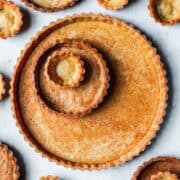
Pâte Sucrée (Sweet Tart Dough)
A simple, no-fuss pâte sucrée that's buttery and tender like a shortbread cookie, yet stable enough for all your favorite tart fillings! This recipe makes one large tart, four mini tarts, or over a dozen tartlets. See the post above for a detailed "Yield and Baking Times" guide and instructions for other pan sizes.
Servings 1 batch of dough (enough for 1 large 9.5" tart, 4 mini tarts, or 14 tartlets)
Ingredients
PÂTE SUCRÉE (SWEET TART DOUGH)
- 113 grams unsalted butter room temperature
- 50 grams granulated sugar
- ½ teaspoon kosher salt Diamond Crystal
- 120 grams all purpose flour
- 1 large egg yolk
- 1 large egg white for egg wash
- 15 mL water for egg wash
Instructions
PÂTE SUCRÉE (SWEET TART DOUGH)
- Into the bowl of a stand mixer fitted with paddle attachment, add the butter, sugar and salt. Beat on medium speed until mixture is well combined. Scrape down sides of bowl.113 grams unsalted butter, 50 grams granulated sugar, ½ teaspoon kosher salt
- Add flour. Mix on low speed until coarse and grainy, about 1 minute. Scrape sides to incorporate all butter. Butter pieces should break down into a combination of sandy mixture and very small lumps.120 grams all purpose flour
- Add the egg yolk and mix for about 30 seconds to 1 minute. The dough should start to pull together into a ball. Even if it doesn't, the dough should stay together when you pinch it between your fingers.1 large egg yolk
- Dump the mixture out onto a large piece of parchment paper.
- Press the dough into a disc shape and cover with another piece of parchment.
- Roll the dough into an 11 inch diameter circle with a thickness of slightly less than ¼ inch thick (6 mm)If dough is still cool enough to be workable, proceed. If dough is sticky and warm, place in fridge for 5-10 minutes before proceeding to the next step.
- Peel the top layer of parchment off the dough. Loosely replace the parchment, flip the dough over, and discard the top layer of parchment.
- Use your hand under the parchment to carefully flip the rolled out dough onto the tart pan.
- With one hand, carefully lift the sides of the dough away from the sharp tart edge. Using your other hand, gently press the dough into the base and corners of the pan. Leave extra dough overhanging the tart. Ensure that no empty air space remains between the dough and the pan. If any cracks or tears occur, patch with extra dough scraps. It's very forgiving!
- Move untrimmed tart onto a baking sheet and and chill in the fridge, uncovered, for a minimum of 1 hour.
- Remove chilled tart from refrigerator. Trim the excess dough with a knife held parallel to your work surface to ensure the tart shell has a clean edge.
- Use a fork to dock the base of the dough (prick holes in it.) Hold the fork flat to dock the sides of the tart in two horizontal rows.See process photos in recipe instructions for details. If using a perforated tart pan, docking should not be necessary.
- Place tart shell in freezer to chill while oven preheats.
- Preheat oven to 350 degrees Fahrenheit (177° Celsius, Gas mark 4) with rack in center of oven.
- Place tart shell onto a parchment lined baking sheet and bake for 10-15* minutes if par baking, and 20-25* minutes if blind baking, until crust becomes dull and is beginning to turn a pale golden color.Remove from oven and let cool for 3-5 minutes.NOTE on Timing: Use the shorter time (10 min par, 20 min blind) for mini tarts and tartlets. Use the full time (15 min par, 25 min blind) for full-size tarts (including round and rectangular pans). See the Yield and Baking Times section in the post above for full details.
- Whisk together the egg white and water in a small bowl. Using a pastry brush, brush the base and sides of the tart with the egg white.1 large egg white, 15 mL water
- Bake tart crust for an additional 5-10 minutes, to desired shade of golden brown. You may need to add a pie shield here to protect the edges of the tart from browning too much. Strips of aluminum foil are fine, too.
- Remove from oven. Cool completely in tart pan on a cooling rack.
Notes
For detailed yields and baking times for all pan sizes, including mini tarts, tartlets, and rectangular pans, please see the Yield and baking times section in the post above.
For instructions on how to scale this recipe for an 11-inch round pan, please see the Frequently asked questions section in the post.
Dough thickness
This recipe specifies rolling the dough to ¼ inch (6mm) thickness. My preference is for a slightly thicker, sturdier crust. It's still crispy, tender and leaves plenty of space for delicious fillings.
Many recipes call for rolling pate sucree dough to ⅛ inch (3mm) thickness. If you prefer a thinner dough, you will need to reduce the baking time by at least 5 minutes.
Leftover dough scraps
If you have dough scraps left over, cut out small shapes with cookie cutters, and bake them. Start checking them for doneness around 10 minutes. You can use the baked dough scraps to decorate the top of your filled tart. (Or eat them plain or sandwiched with something sweet in the middle.)
Egg white note
If you're using up an egg yolk and don't have an egg white handy, you can skip the egg wash. If you're concerned about sealing the tart base, you can brush a very thin layer of melted chocolate (white, milk or dark) onto the cooled tart base instead.